![[Translate to English:] Schlüsselübergabe vor einem Mercedes-Benz eEconic.](/fileadmin/_processed_/7/1/csm_HD_E_econic_Kessel_ce178e6061.webp)
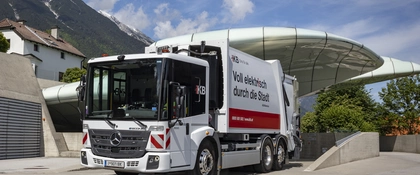
Mercedes-Benz Trucks is handing over the first five of ten eEconic vehicles to Stuttgart Waste Management.
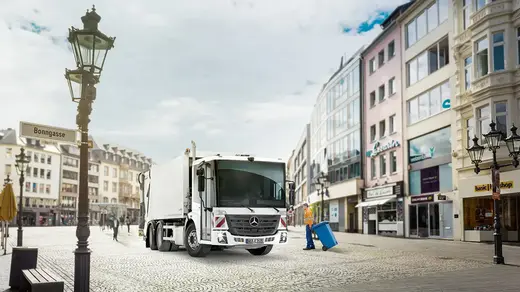
Steep hills, narrow roads, heavy traffic: Stuttgart poses a challenge for its waste collection services. The first five of ten battery-electric eEconics are now on the road for Stuttgart’s waste management service – quiet, locally CO₂e-free and backed by a depot that is fully geared towards electric mobility.
Kick-off in Wangen.
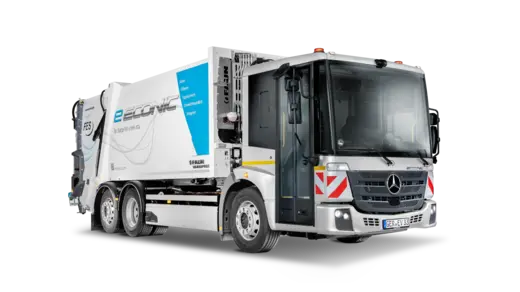
Waste collection in Stuttgart is precision work. From now on, part of this work will be carried out using battery-electric vehicles: Mercedes-Benz Trucks has handed over the first five of ten eEconics to Abfallwirtschaft Stuttgart (AWS). Each vehicle is fitted with a FAUN Variopress rear loader with a capacity of 21 m³ and a FAUN Skylift tipper. At the same time, AWS has procured ten diesel-powered Econics.
![[Translate to English:] Besucherinnen und Besucher feiern die Einweihung der neuen AWS-Betriebsstelle.](/fileadmin/_processed_/2/2/csm_CT_E_econic_Kessel_e7f37c756d.webp)
The vehicles were handed over at the opening ceremony for the new facility in Stuttgart-Wangen. AWS also invited local residents to the event: anyone who wished could explore the site and take a look behind the scenes at the city’s waste management operations.
Electricity from your own roof.
From the outset, the site was designed with the use of electric vehicles in mind: nine overhead charging units for lorries, several charging points for cars and two fast-charging points. Part of the electricity is supplied by the building’s roof, which is home to one of the largest photovoltaic systems installed on an urban building in Stuttgart.
The electric refuse collection lorries represent a quantum leap for Stuttgart
Markus Töpfer, Managing Director, Stuttgart Waste Management
Technology that makes life easier.
The eEconic 300 has been in series production at the Mercedes-Benz plant in Wörth am Rhein since 2022. Three battery packs, each with an installed capacity of 112 kWh and a usable capacity of around 97 kWh, cover typical collection routes in single-shift operation – without the need for recharging en route. 1
The tried-and-tested low-floor design significantly reduces the step-in height, which pays off on every journey. The ability to get in and out on the side facing away from the traffic is also particularly practical given the frequent stops involved in refuse collection operations. The low-slung panoramic windscreen provides a clear view of the immediate surroundings, enabling eye contact with other road users.
And then there’s the quiet. Without the noise of the diesel engine, communication in the cab is easier and stress levels are reduced over the course of a whole shift. Local residents notice the difference too – particularly during early-morning rounds. Markus Töpfer highlights this very point: despite the challenging topography of the Stuttgart basin, the vehicles have proved their worth and improved working conditions for staff.
![[Translate to English:] Orangefarbene Mercedes-Benz eEconic Abfallsammelfahrzeuge unter dem überdachten Vorplatz der neuen AWS-Betriebsstelle in Stuttgart-Wangen](/fileadmin/_processed_/c/0/csm_CT_E_econic_Kessel_2_ac78acd3cc.webp)
For Christian Wilz, Chairman of the Executive Board of Mercedes-Benz Trucks Germany, the handover is, above all, a shared milestone: it represents locally CO₂e-free, low-noise collection vehicles in urban environments – underpinned by a long-standing partnership and the aim of putting solutions for the recycling cycle into practice.
1The range stated is provisional and was calculated using an internal simulation tool, assuming optimal conditions, including 3 new battery packs following preconditioning in a partially charged state, for inner-city refuse collection (VECTO Municipal Cycle up to 100 km) or mixed refuse collection (a combination of the VECTO Municipal Cycle, VECTO Regional Delivery and VECTO Urban Delivery Cycle, up to 150 km) at an outside temperature of 20 °C, and may differ from the values determined in accordance with Regulation (EU) 2017/2400. The actual range depends heavily, amongst other things, on driving behaviour, the operational profile and the type of bodywork.