With a combination of Herculean strength and state-of-the-art technology: Unimog U 430 in winter Services.
A brand-new Unimog ensures that one of Switzerland’s oldest cog railways can start into the season in the Bernese Oberland.
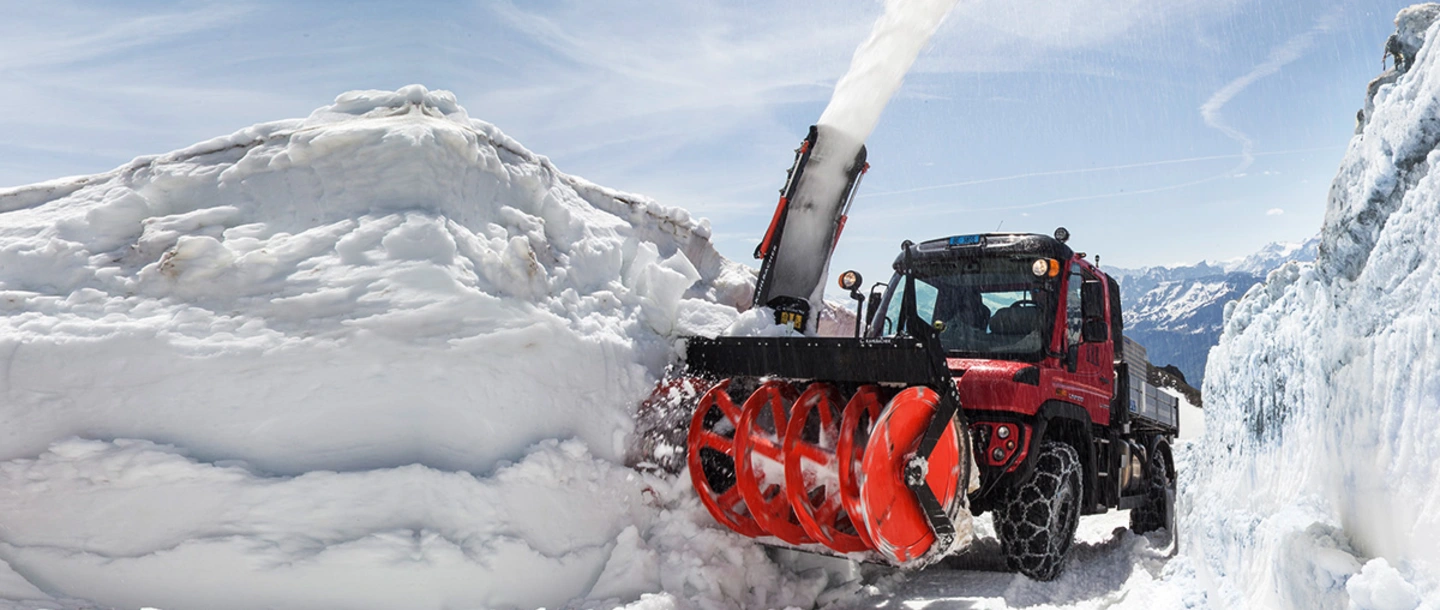
Metre for metre, the Unimog U 430 works its way forward,with 220 kWof sheer power! The rotary snow plough mounted at the front cuts through the glistening white top edge of the snow. From the ejection chute the snow flies in a high arc and splatters onto the steep slope a few metres further down.Way down in the valley Lake Brienz sparkles in the morning sun, against the majestic backdrop of the Bernese Alps with the famous trio of Eiger, Mönch and Jungfrau. This is a spectacle Frank Zobrist has no time to enjoy. Hismission is to clear the tracks of the Brienz Rothorn railway below the upper station still covered in deep snow even at the end of May.
“After a normal winter, the snow here is four to six metres deep. Sometimes even ten,” says Daniel Schlosser, technical director of the railway, one of the oldest cog railways in Switzerland, in service since 1892. Steam locomotives still predominate on the 7.6 kilometre route. At present, the route continues to the middle station, where gentian violets have already been in bloom for some time now. However, most passengers want to go right to the very top, at an altitude of 2 244 metres. Waiting for the snow to thaw of its own accordwould takeweeks. And the season reallymust be in full swing by early June – it only lasts until the end of October.
Teamwork is the key.
For this reason, it is always time to clear the snow frommid-May. “A team of five usually handles that task,” says Daniel Schlosser: Two railway employees use hand-held snow ploughs to remove the snowy peaks. A third colleague uses a PistenBully (ski-slope maintenance vehicle) to clear a first rough track. Colleague number four clears rocks away. Colleague number five – Frank Zobrist, who heads the clearance crew – then uses the Unimog to clear the bulk of the snow.
This year work began above the middle station, with the clearing of individual snowfields. All the men know the terrain like the back of their hands, especially the most snow-critical zone at an altitude of about 2 000 metres: it is in the shape of a funnel where the track traverses the slopes in a steeply rising curve hundreds of metres long.